Article
One product record ends Excel-and-email style sprawl.
What the slide argues
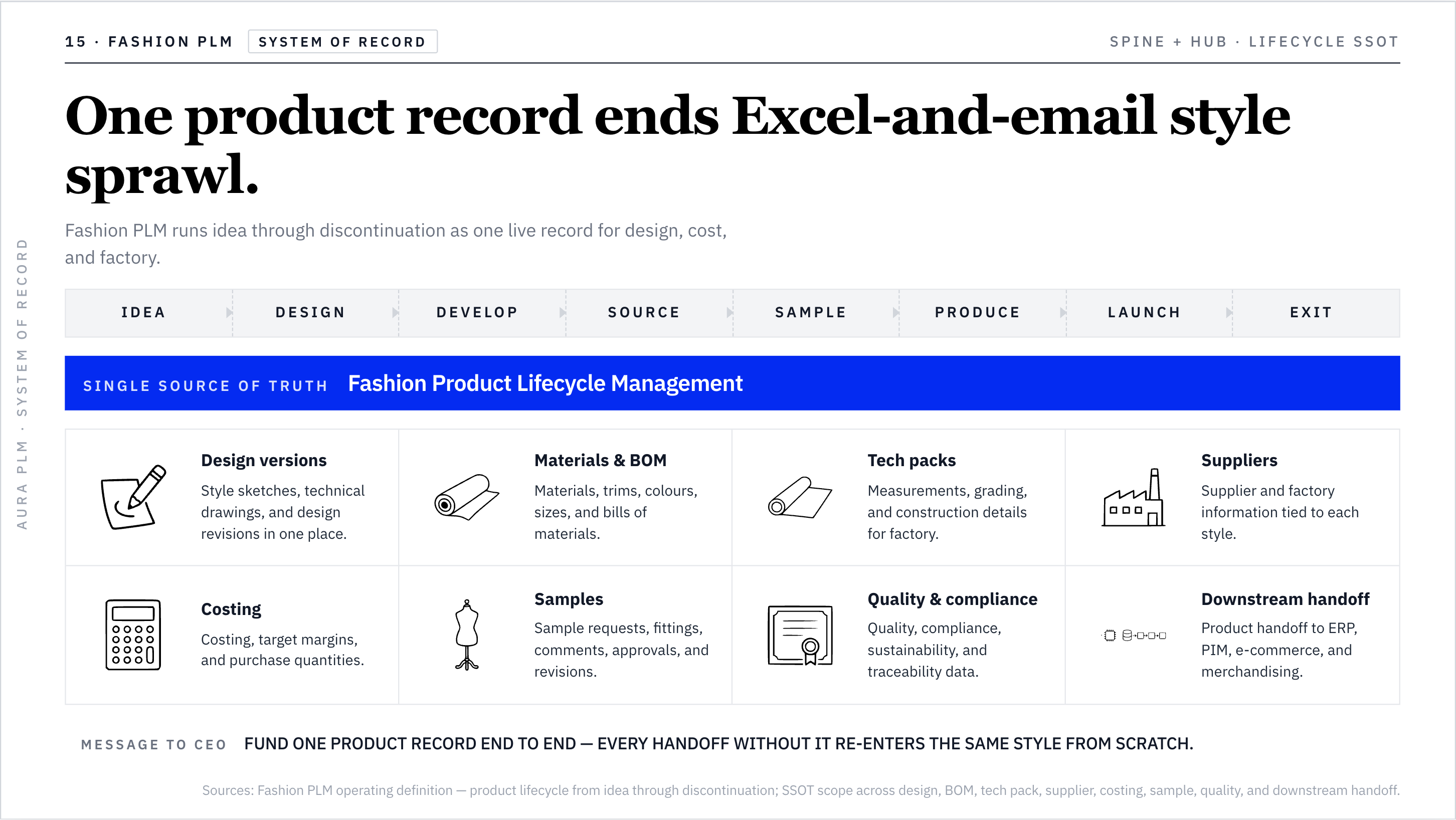
Fashion PLM runs idea through discontinuation as one live record for design, cost, and factory. When that record forks across Excel, email, PDFs, and chat threads, every stage rebuilds style truth before the next owner can act. The record has to hold design versions — style sketches, technical drawings, and design revisions in one place — or design itself is already fragmented. It also has to carry downstream handoff cleanly into product handoff to ERP, PIM, e-commerce, and merchandising, or the launch path re-enters the same style from scratch.
What the exhibit shows
The exhibit below spans the product lifecycle and the domains the single record must hold. Read the spine as the path; read the grid as the minimum scope of one source of truth.
Slide analysis
Lifecycle scope of the record
- Single source of truth — Fashion Product Lifecycle Management is the operating definition of one live product record on this slide.
- The lifecycle spine runs Idea → Design → Develop → Source → Sample → Produce → Launch → Exit — the record must travel intact, not restart at each handoff.
- The domain grid is MECE scope for what that record must hold, not a feature menu.
- Miss any domain and the next owner rebuilds the missing slice from email or a local sheet.
Upstream product definition
- Design versions: style sketches, technical drawings, and design revisions in one place — required on the same live record as the rest of the style.
- Materials & BOM: materials, trims, colours, sizes, and bills of materials — required on the same live record as the rest of the style.
- Tech packs: measurements, grading, and construction details for factory — required on the same live record as the rest of the style.
- When sketches, BOM lines, and construction live in separate files, every revision recreates the style before sourcing sees it.
Commercial and supply decisions
- Suppliers: supplier and factory information tied to each style — required on the same live record as the rest of the style.
- Costing: costing, target margins, and purchase quantities — required on the same live record as the rest of the style.
- Split those fields across spreadsheets and margin targets drift from the BOM the factory is building.
Execution, compliance, and handoff
- Samples: sample requests, fittings, comments, approvals, and revisions — required on the same live record as the rest of the style.
- Quality & compliance: quality, compliance, sustainability, and traceability data — required on the same live record as the rest of the style.
- Downstream handoff: product handoff to ERP, PIM, e-commerce, and merchandising — required on the same live record as the rest of the style.
- Approvals, compliance evidence, and ERP/PIM/e-commerce handoff all fail the same way when the record forks.
Fragmentation contrast on the slide
- Instead of Excel, email, PDFs, WhatsApp, and cloud folders, PLM connects product development in one structured platform.
- That contrast is the operating choice: one structured platform versus disconnected files that force every handoff to rebuild style truth.
Implication
Fund one product record end to end — every handoff without it re-enters the same style from scratch. That is the operating choice the exhibit forces: fund one record, or keep paying the rebuild tax at every handoff. The decision is commercial, not cosmetic: either the style has one home, or every function keeps its own copy.
Sources
Sources: Fashion PLM operating definition — product lifecycle from idea through discontinuation; SSOT scope across design, BOM, tech pack, supplier, costing, sample, quality, and downstream handoff.