Article
Fashion PLM compresses calendar, cost, and rework—with ROI inside 18–36 months.
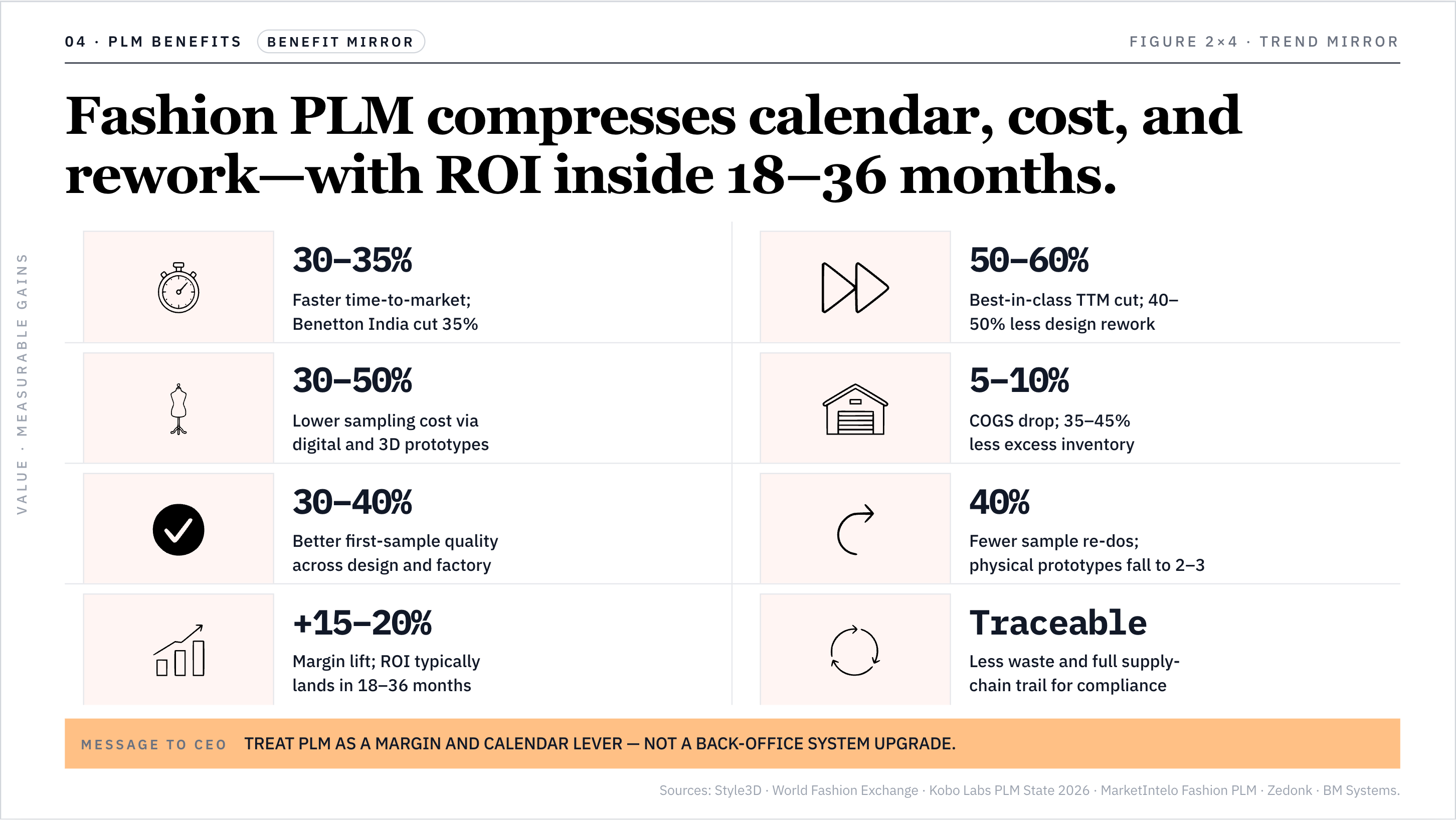
Brands that run product from a single source of truth compress development before factory. Typical adopters cut time-to-market by 30–35% (Benetton India cut 35%).
The exhibit below mirrors the measured gains across speed, cost, quality, and return — one causal chain for the decision-maker, not a menu of optional themes.
On speed, brands cut time-to-market by 30–35% (Benetton India cut 35%). The same programs compress time-to-market by 50–60% at the best-in-class end, and cut design rework by 40–50%.
Cost follows the calendar gain: programs reduce sampling cost via digital and 3D prototypes by 30–50%, and cut COGS by 5–10%, with 35–45% less excess inventory.
Quality tightens when teams share one product truth — programs improve first-sample quality across design and factory by 30–40%, and cut sample re-dos by 40% (physical prototypes fall to 2–3).
The commercial and compliance return closes the chain — programs lift margins 15–20% (ROI typically lands in 18–36 months), and less waste and full supply-chain trail for compliance.
Treat PLM as a margin and calendar lever — not a back-office system upgrade.
Sources: Style3D · World Fashion Exchange · Kobo Labs PLM State 2026 · MarketIntelo Fashion PLM · Zedonk · BM Systems.